Brenda Pagliaro, Esq.
*Florida Supreme Court Certified Circuit Civil Mediator *
Florida Supreme Court Qualified Arbitrator
Artificial intelligence is rapidly becoming part of everyday business decision making from recruiting and hiring to marketing, lending, customer service, healthcare, and risk management. Given its increased use, the question begs: who is responsible when an AI system produces a discriminatory or otherwise potentially unlawful result? The pending litigation in *Mobley v. Workday, Inc. *may set precedent in answering that question.
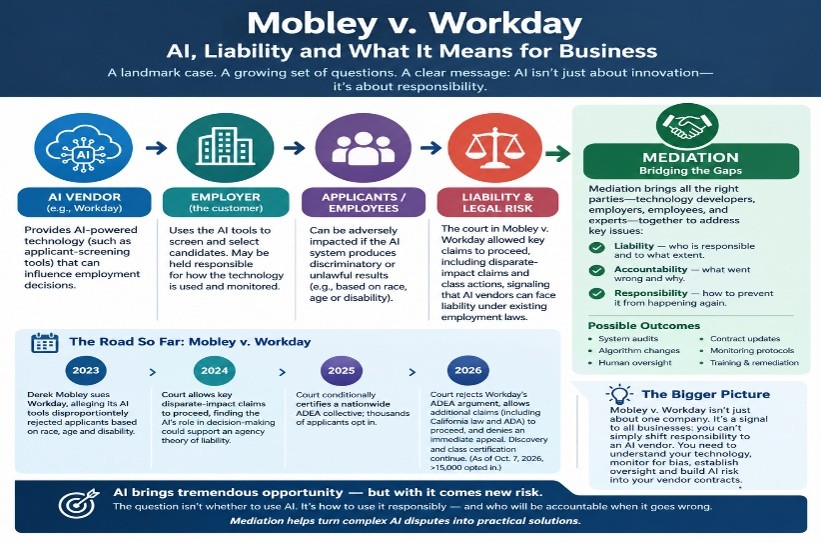
Derek Mobley sued Workday in 2023, alleging that its AI-powered applicant-screening tools disproportionately rejected applicants based on race, age, and disability. Workday argued, among other things, that it provides software to employers rather than making employment decisions itself. The case has become an important test of whether an AI vendor can face liability when its technology materially influences a customer's employment decisions.
In 2024, the federal court allowed key disparate-impact claims to proceed, reasoning that the alleged role of Workday's technology in the decision-making process could support an agency theory of liability. The court emphasized that the fact that the delegated function was performed through AI, rather than by a human, did not necessarily remove it from existing employment discrimination law and thus, potential liability.
The case expanded significantly in 2025. In May, the court conditionally certified a nationwide ADEA collective involving applicants age 40 and older who were screened using Workday s tools. To date, more than 15,000 people have opted into the ADEA class.
As the case continues, developments in 2026 found the court rejecting Workday's argument that the ADEA does not permit disparate impact claims by job applicants. The court also allowed amended claims, including claims under California law and the ADA. As of October 2026, discovery and class-certification proceedings continue to move forward.
The business lesson is bigger than Workday. The Mobley litigation signals that companies cannot necessarily shift responsibility, or liability for that matter, to another simply by saying, The algorithm made the decision. When deploying AI, every business needs to understand how the technology and process works, the source and integrity of the data, verify it is tested for discriminatory or harmful outcomes, provide process and document oversight, establish human review where appropriate, and address AI risk in vendor contracts. Every business needs to be prudent and have an AI risk mitigation framework and process in place prior to deployment.
Should issues arise, this is where mediation can play a key role. AI disputes can involve multiple potentially responsible parties such as the technology developer, the business deploying it, employees who configure or rely on it, and sometimes third-party data providers. Litigation in these matters may ultimately determine legal liability but mediation can help the parties circumvent lengthy and costly litigation.
A skilled mediator can bring the parties together to help flesh out issues in addition to liability and damages by facilitating communication and knowledge sharing. Additional issues may include where the process failed, who controlled which part of the process, what safeguards were in place, and what should change going forward. Another benefit of mediation is that it is confidential and flexible, where a resolution can address more than money. Mediation allows for creative resolutions that may include human oversight with quality assurance and system audits, monitoring protocols, training, remediation, and governance.
As AI becomes more embedded in business, the question is no longer whether companies will use it. The more important question is how they will use it responsibly and who will be accountable when it goes wrong. Mobley v. Workday makes clear that all businesses need to address these questions before a dispute reaches the courtroom.
